Introduction
Welcome to the future, where artificial intelligence (AI) is not just a buzzword but an accessible reality for innovators and entrepreneurs across the globe. The realm of AI applications is vast, ranging from simple chatbots to complex predictive analytics systems. But how does one take the first steps towards building an AI application?
In this guide, we’ll walk through the pivotal phases of crafting your AI application, highlight the tools you’ll need, and offer insights to set you on the path to AI success. Whether you’re a seasoned developer or a curious newcomer, this guide promises to unravel the mysteries of AI development and put the power of intelligent technology in your hands.
Creating an AI Application
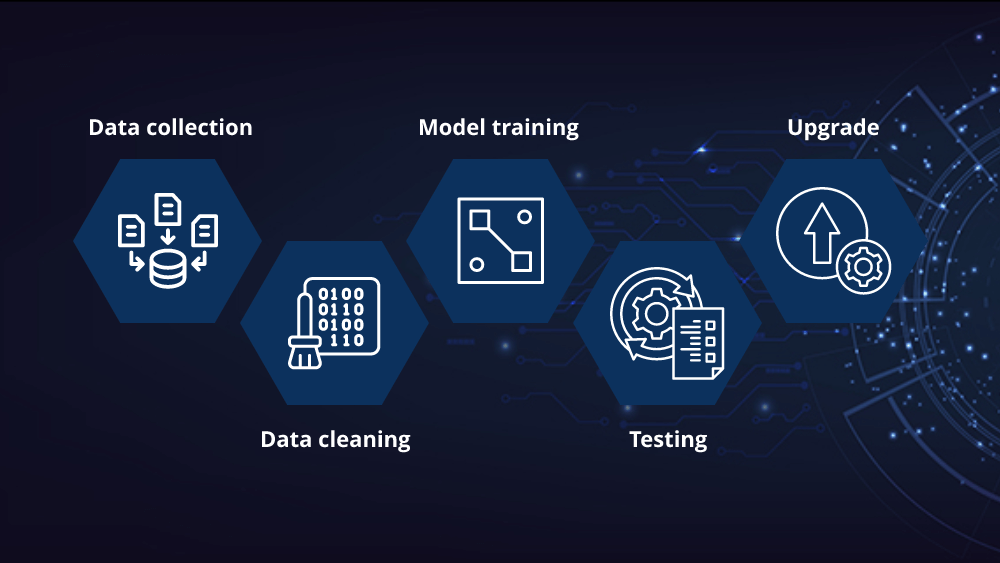
Creating an AI application is an exciting venture that requires careful planning, a clear understanding of objectives, and the right technical skills and resources. Here’s a step-by-step guide to help you get started:
- Define Your ObjectiveDetermine what problem you want to solve with your AI application.Identify the needs of your target users and how your AI solution will address those needs.
- Conceptualize the AI ModelDecide on the type of AI you want to create. Will it involve natural language processing, computer vision, machine learning, or another AI discipline?Sketch out a high-level design of how the model will work, its inputs and outputs, and the user interactions.
- Gather Your DatasetCollect relevant data that your AI model will learn from. The quality and quantity of data can significantly impact the accuracy and performance of your AI application.Ensure that you have the right to use the data and that it’s free of biases to the best of your ability.
- Choose Your Tools and TechnologiesSelect programming languages that are commonly used for AI, such as Python or R.Choose appropriate AI frameworks and libraries, like TensorFlow, PyTorch, Keras, or scikit-learn.
- Develop a PrototypeStart coding your AI model based on the frameworks and datasets you’ve selected.Develop a minimum viable product (MVP) or prototype to test the feasibility of your concept.
- Train and Test Your ModelUse machine learning techniques to train your AI model with your dataset.Test your AI model rigorously to evaluate its performance, accuracy, and reliability.
- Incorporate FeedbackGather feedback by testing your prototype with potential end-users.Make iterative improvements based on the feedback and continue refining your AI model.
- Ensure Ethical Considerations and ComplianceConsider the ethical implications of your AI application and ensure that it complies with relevant AI ethics guidelines and regulations.Include privacy measures and data security to protect user information.
- Deploy the ApplicationChoose a cloud platform or in-house servers to deploy your AI application.Ensure that you have the appropriate infrastructure to support the AI application’s computational and storage needs.
- Monitor and MaintainAfter the deployment, monitor how the application performs in the real world.Set up processes for ongoing maintenance, updates, and performance tuning.
- Scale Your AI ApplicationAs your user base grows and your application proves successful, consider scaling your infrastructure.Explore possibilities for expanding your AI application’s features and reach.
Throughout this process, it may be beneficial to collaborate with AI experts, data scientists, and developers, especially if you’re new to the field of artificial intelligence. Remember that creating a successful AI application is not just about technical excellence; it’s also about understanding and delivering value to users in a responsible and ethical way.
Tools and Software options that Can Assist You
Data Collection and Processing:
Web Scraping Tools: Octoparse, Import.io
Data Cleaning Tools: OpenRefine, Trifacta Wrangler
Programming Languages:
Python: Widely used for AI due to libraries like NumPy, Pandas, and a supportive community.
R: Great for statistical analysis and data visualization.
AI Frameworks and Libraries:
TensorFlow: An end-to-end open-source platform for machine learning.
PyTorch: An open-source machine learning library based on the Torch library.
Keras: A high-level neural networks API, written in Python and capable of running on top of TensorFlow, CNTK, or Theano.
scikit-learn: A Python library for machine learning and data mining.
AI Development Platforms:
Google AI Platform: Offers a managed service for deploying ML models.
IBM Watson: Hosts a suite of AI tools for building applications.
Microsoft Azure AI: A collection of services and infrastructure for building AI applications.
Data Storage and Computation:
Cloud Services: AWS, Google Cloud Platform, Microsoft Azure
Big Data Platforms: Apache Hadoop, Apache Spark
Data Visualization:
Tableau: A powerful business intelligence and data visualization tool.
PowerBI: A business analytics service by Microsoft.
Version Control:
Git: Widely used for code version control.
GitHub/GitLab: Online platforms that provide hosting for software development and version control using Git.
Machine Learning Model Training and Evaluation:
MLflow: An open-source platform for the machine learning lifecycle.
Weights & Biases: Tools for tracking experiments in machine learning.
Deployment and Monitoring:
Emerging AI: An autoscaled scheduling service towards stable and economical serverless LLM serving. Automate deployment processes for efficient LLM service management without manual intervention.
Docker: A tool designed to make it easier to create, deploy, and run applications by using containers.
Kubernetes: An open-source system for automating deployment, scaling, and management of containerized applications.
Prometheus & Grafana: For monitoring deployed applications and visualizing metrics.
Ethics and Compliance:
AI Fairness 360: An extensible open-source toolkit for detecting and mitigating algorithmic bias.
Collaboration and Project Management:
JIRA: An agile project management tool.
Slack: For team communications and collaboration.
These tools serve different aspects of the AI development lifecycle, from planning and building models to deploying and monitoring your application. It’s important to choose the right set tools that match the specific requirements of your AI project and your team’s skills.
Conclusion
Congratulations on completing your explorative expedition into the world of AI application development. By now, you should have a road map etched in your mind, punctuated by the landmarks of defining your project’s goals, selecting the appropriate tools, training your model, and ultimately, watching your AI solution come to life. The journey might seem arduous, marked with challenges and the need for continual learning, but the rewards are equally great—bringing forth an application that harnesses the power of AI to solve real-world problems.
Remember, your journey doesn’t end with deployment; the iterative process of refining your application based on user feedback and advancing technology is what will keep your AI application not just functional but formidable. So venture forth with confidence, knowing you are now armed with the knowledge to transform the seeds of your AI aspirations into the fruits of innovation. Keep innovating, keep iterating, and let your AI application be a testament to the intelligence and ingenuity you possess.
- Introduction
- Creating an AI Application
- Tools and Software options that Can Assist You
- Data Collection and Processing:
- Programming Languages:
- AI Frameworks and Libraries:
- AI Development Platforms:
- Data Storage and Computation:
- Data Visualization:
- Version Control:
- Machine Learning Model Training and Evaluation:
- Deployment and Monitoring:
- Ethics and Compliance:
- Collaboration and Project Management:
- Conclusion